

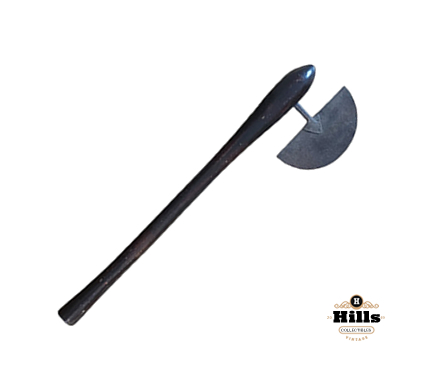
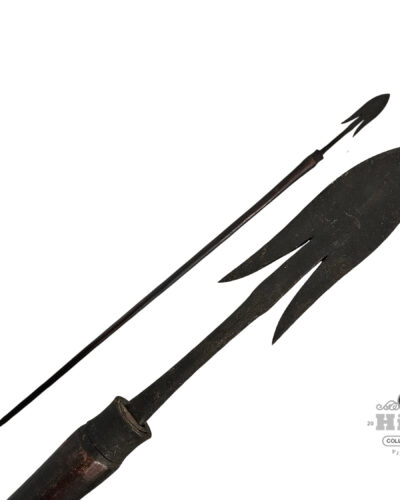
Authentic Zulu Half-Moon Battle Axe (isiZenze)
This striking isiZenze is a premier example of Zulu martial heritage and a high-status prestige object. While the iklwa (stabbing spear) was the tactical mainstay of the Zulu military, the crescent-bladed axe was a “royal” weapon, traditionally carried by senior warriors, indunas, and chiefs as a visible emblem of authority and rank.
Historical & Scholarly Context
This specimen is a textbook example of the transitional period in Nguni material culture. Its construction aligns with the research of Tim Maggs, specifically his landmark study on the evolution of Zulu weaponry.
- Blade Construction: The blade is forged from industrial sheet steel, likely repurposed from high-quality metal imported from the United Kingdom. This follows the typology identified in Figure 7.1 of Maggs’ “The Zulu battle-axe” (1992), documenting how 19th-century local artisans adapted durable industrial materials for traditional artisanal forms.
- Artisanal Forging: Although the raw material was sourced via trade, the shaping and finishing were executed by skilled local blacksmiths. The blade is securely hafted through a slot in the hardwood handle, demonstrating traditional mounting techniques.
Physical Attributes & Patina
- Indigenous Hardwood Haft: The handle is carved from a dense, singular piece of indigenous South African hardwood. It features a sleek, tapering profile that swells into a beautifully polished, bulbous pommel at the grip end for balanced handling and status display.
- Patina & Condition: The wood displays a rich, dark lustrous patina with surface wear and minor nicks consistent with a genuine 19th-century artifact. The blade shows authentic age-related oxidation and a subtle, hand-forged texture that verifies its period origin.
Reference
Maggs, T. (1992). The Zulu battle-axe: Its origins and significance. Annals of the Natal Museum, 33(2), 175–187.

Reviews
There are no reviews yet.